How I Increased Google AI Overview Visibility for a Local Business – Siddique Akbor Emon
Client Information
Client Type: Commercial Cleaning Business
Industry: Local Service Business
Project Duration: 4 Months
Services Provided: Technical SEO, On-Page SEO, Local SEO, Content Strategy, Google Business Profile Optimisation, Schema Markup, Authority Building, AI Search Optimisation
Project Overview
Google Search is evolving beyond traditional blue-link rankings. With Google AI Overviews, users can increasingly discover businesses through AI-generated answers that summarise information from multiple sources.
For this local business, the objective was to strengthen its overall search presence and increase its visibility across Google Search, local search and Google AI Overviews.
Before the campaign, the business had limited visibility for important commercial searches, lacked strong topical coverage and had little presence across emerging AI-powered search experiences. This limited its ability to reach potential customers at the exact moment they were researching local services.
I developed and implemented a focused SEO strategy combining technical SEO, on-page optimisation, local SEO, content optimisation, structured data, authority building and AI search optimisation.
The campaign resulted in stronger organic visibility, improved local search presence and increased opportunities for the business to appear in AI-generated search experiences.
Results
The campaign produced measurable improvements across traditional search and local visibility.
Key Results
- Organic Traffic: 1200%+
- Organic Impressions: 18.8K
- Organic Clicks: 244
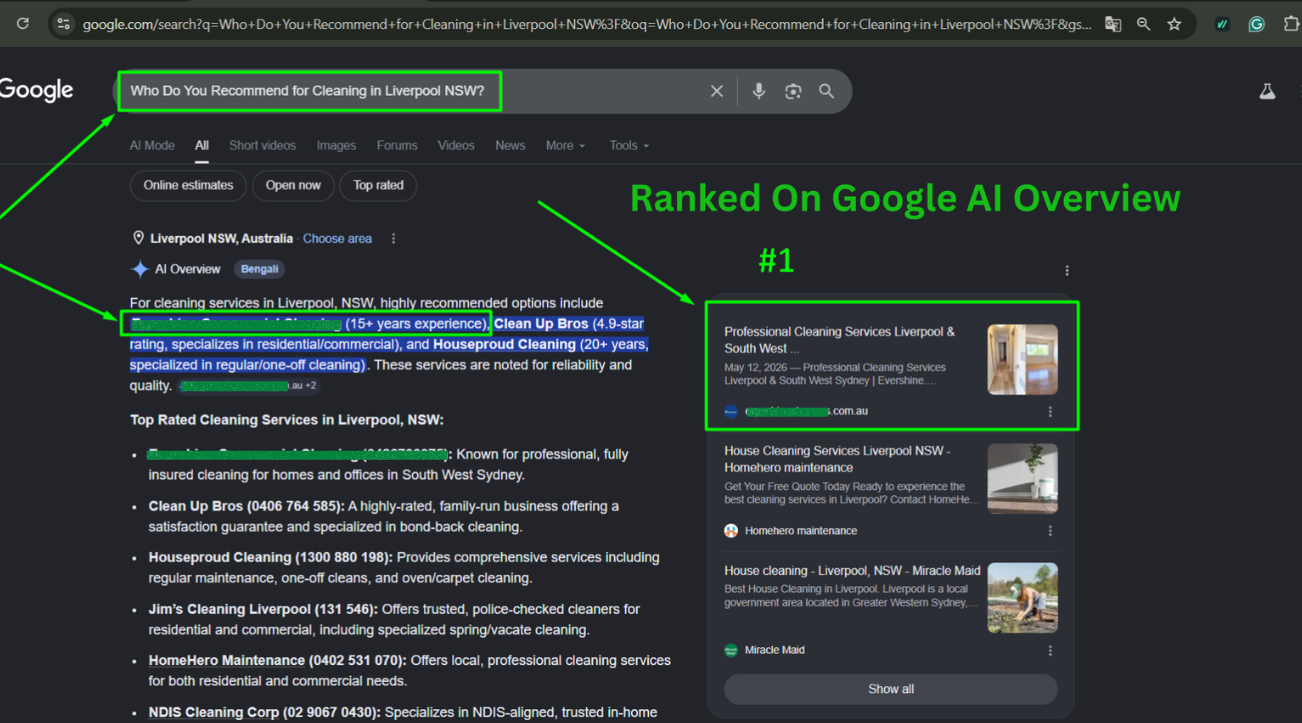
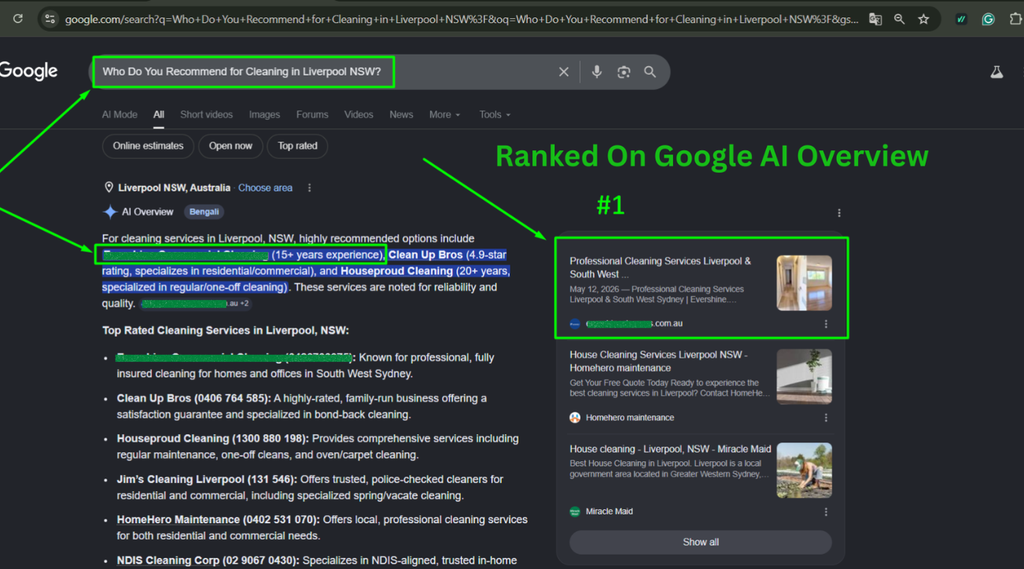
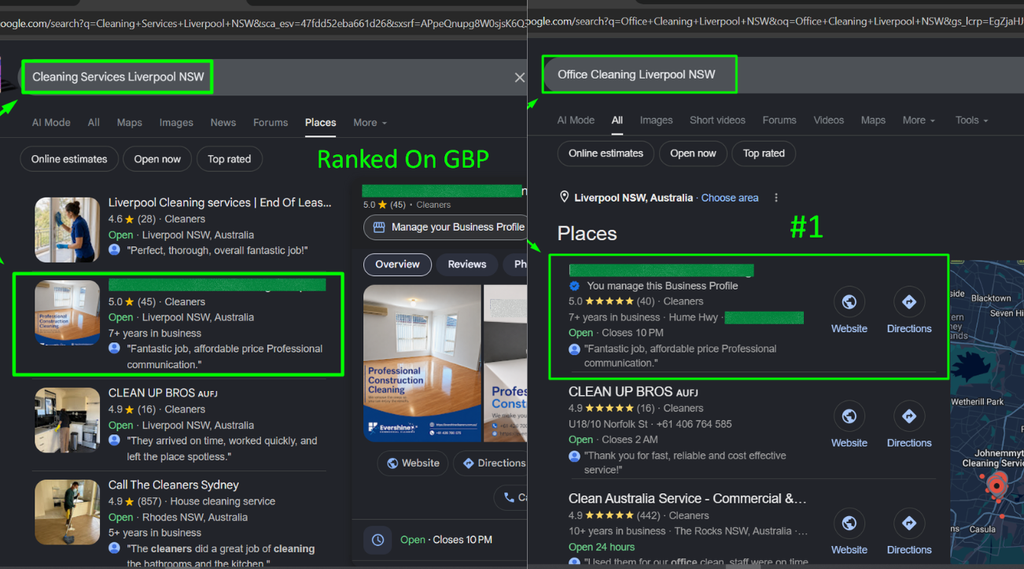
- Keyword Ranking: #1
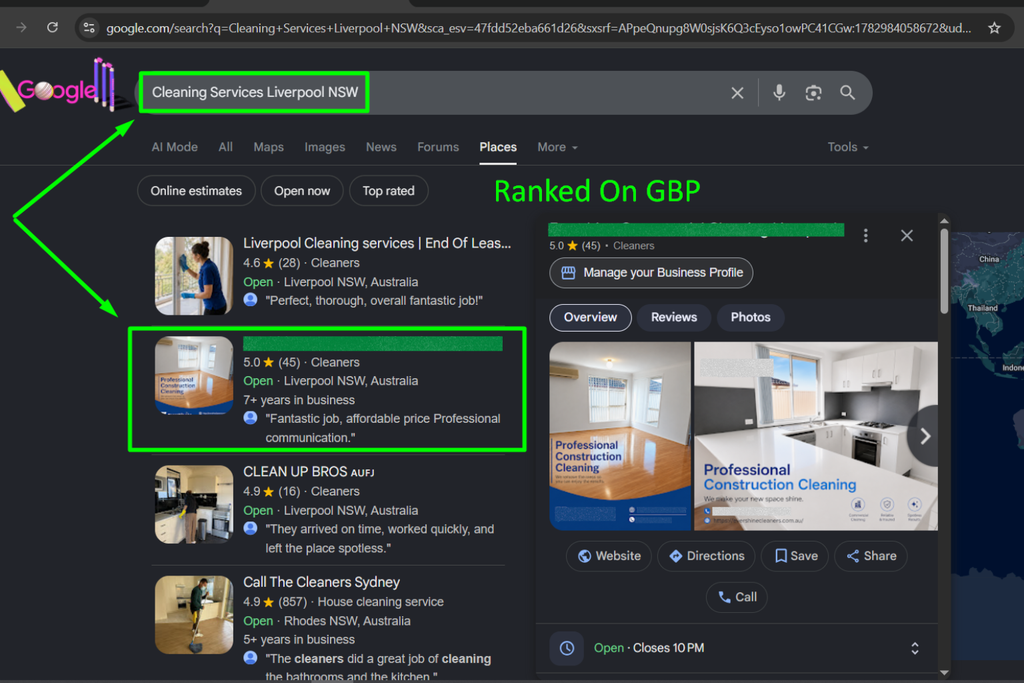
- Google Maps Visibility: 170%
Google AI Overview Visibility
Google Maps / Local Visibility
The Challenge
Before the campaign began, the business faced several SEO challenges that were limiting both traditional search visibility and its ability to be discovered through newer AI-powered search experiences.
1. Limited Organic Search Visibility
The website was not consistently ranking for many of the commercial and location-based searches that potential customers were using.
This meant the business was missing opportunities to reach users who were actively looking for its services.
2. Weak Local Search Presence
Local visibility was another major challenge. The business needed stronger relevance for searches with local intent, particularly searches combining its services with specific locations.
Without strong local signals, it was more difficult to compete with established businesses in the area.
3. Insufficient Topical Coverage
The existing website did not adequately cover the questions, services, problems and location-specific topics relevant to the target audience.
This created gaps in Google’s understanding of the business and reduced the website’s ability to demonstrate expertise across its core service areas.
4. Limited AI Search Visibility
Google AI Overviews introduce another layer of search visibility. Instead of simply displaying traditional rankings, Google can generate an answer and reference sources that it considers useful and relevant.
The business had not been strategically optimised for this environment, meaning there was an opportunity to improve how its expertise, services and business information were understood and surfaced.
5. Weak Authority and Trust Signals
The website needed stronger signals demonstrating relevance, expertise and credibility.
For a local business, these signals can come from consistent business information, quality content, relevant mentions, authoritative links, customer-focused information and a well-optimised Google Business Profile.
Project Goals
Before implementing the campaign, I established several measurable objectives:
- Increase organic search visibility for commercially valuable keywords
- Improve rankings for important service and location-based searches
- Increase qualified organic traffic
- Strengthen Google Maps and local search visibility
- Improve the website’s topical relevance and authority
- Optimise important pages for answer-focused search behaviour
- Improve the business’s eligibility for AI-powered search visibility
- Strengthen the overall digital authority of the business
- Generate more opportunities for qualified leads and enquiries
The focus was not simply on achieving higher rankings. The goal was to build a search presence capable of generating visibility, trust, qualified traffic and business opportunities.
My SEO Strategy
I approached the campaign as a complete search visibility project rather than treating Google AI Overviews as a standalone ranking factor.
The strategy focused on strengthening the signals that help search engines understand what the business offers, where it operates, who it serves and why its information should be trusted.
1. Technical SEO Optimisation
I first reviewed the technical foundation of the website to identify issues that could affect crawling, indexing, usability and search performance.
This included:
- Crawlability analysis
- Indexation checks
- XML sitemap review
- Robots.txt analysis
- Canonicalisation
- Broken links
- Redirect issues
- Website architecture
- Mobile usability
- Core performance considerations
- Duplicate content
- Internal linking
Why it mattered
AI search visibility still depends on search engines being able to access, understand and interpret the underlying website content.
A technically clean website provides a stronger foundation for every optimisation performed later.
2. Keyword and Search Intent Research
I researched keywords around the business’s:
- Core services
- Location
- Service + location combinations
- Commercial searches
- Informational searches
- Problem-based searches
- Question-based searches
- Local search queries
I then mapped keywords according to search intent rather than simply placing keywords throughout the website.
Why it mattered
Different users search differently depending on where they are in the buying journey.
Someone searching for “[service] near me” has a different intent from someone searching “how much does [service] cost?”
Understanding these differences allowed me to create and optimise content that answered the right questions at the right stage.
3. On-Page SEO Optimisation
I optimised the site’s key pages around their primary search intent.
This included:
- Title tags
- Meta descriptions
- H1-H3 structure
- Service descriptions
- Location relevance
- Internal links
- Image optimisation
- Content structure
- FAQs
- Supporting topical information
- Conversion elements
Why it mattered
Strong on-page optimisation helps search engines establish the relationship between the page, the service, the location and the user’s search intent.
It also makes important information easier for both users and search systems to interpret.
4. Local SEO Optimisation
I strengthened the local search signals surrounding the business.
The work included:
- Google Business Profile optimisation
- Business information consistency
- Local keyword optimisation
- Service and category relevance
- Location-focused content
- Local landing page improvements
- Citation consistency
- Local authority signals
- Internal location relevance
Why it mattered
Local customers often search with strong geographic intent.
Improving local relevance helps the business compete for searches where proximity, service relevance and business prominence influence visibility.
5. Content Strategy
I developed a content strategy designed around the questions and problems potential customers were actually searching for.
Content opportunities included:
- Service-focused content
- Location-based content
- Frequently asked questions
- Problem-solving articles
- Comparison content
- How-to content
- Commercial supporting content
Each piece was structured to provide clear, useful and directly answerable information.
Why it mattered for AI search
AI-powered search systems need understandable information that can be interpreted and incorporated into answers.
Clear headings, concise answers, comprehensive explanations and strong topical coverage make important information easier for search systems to process.
6. Content Optimisation for Google AI Overviews
I refined important content to make key information easier to understand and extract.
This involved:
- Clear question-and-answer sections
- Direct answers to common queries
- Descriptive headings
- Concise explanations
- Supporting context
- Strong topical coverage
- Consistent business information
- Relevant supporting content
I also focused on demonstrating genuine expertise rather than creating content purely to target AI-generated answers.
Why it mattered
There is no guaranteed formula for appearing in Google AI Overviews.
Instead, the strategy was to improve the overall quality, relevance, clarity and authority of the information Google could use when generating search answers.
7. Structured Data Implementation
Where appropriate, I implemented and improved structured data to help search engines better understand important information about the business and its website.
Depending on the page, this included relevant schema types such as:
- LocalBusiness
- Service
- Organisation
- FAQ
- Breadcrumb
- WebPage
Why it mattered
Structured data provides search engines with additional machine-readable context about entities, services, pages and business information.
It supports clearer understanding of the website’s content and relationships.
8. Internal Linking Strategy
I improved internal links between important service pages, location pages and supporting content.
The strategy connected:
Core Services → Location Pages → Supporting Content → Related Services
Why it mattered
A strategic internal linking structure helps distribute authority throughout the website and creates clearer relationships between related topics.
It also helps users discover relevant information more easily.
9. Authority Building
I worked on strengthening the website’s authority through relevant off-page SEO activities.
This included:
- Relevant citations
- Quality link opportunities
- Local authority signals
- Brand mentions
- Industry-relevant references
Why it mattered
Search visibility is not determined by on-page optimisation alone.
A website competing in a local market needs sufficient relevance, credibility and authority to compete against established competitors.
Business Impact
The value of the campaign extended beyond rankings.
Increased Search Visibility
The business gained greater exposure across organic, local and emerging AI-powered search experiences.
This increased the number of opportunities for potential customers to discover the company.
Stronger Local Authority
Improved local optimisation helped strengthen the business’s relevance within its target geographic market.
This created a stronger foundation for competing against established local businesses.
More Qualified Traffic
The strategy focused on commercially relevant keywords and search intent rather than generating traffic for irrelevant queries.
As visibility improved for service-focused searches, the website was better positioned to attract users with genuine purchasing intent.
Long-Term Growth
Rather than relying on a single ranking or keyword, the campaign built a broader search ecosystem around the business.
Technical improvements, content, local optimisation, internal linking and authority building created a foundation that could continue generating organic visibility over time.
Client Testimonial
“Working with Siddique was a great experience. He understood our business goals and implemented a clear strategy that improved our visibility and Google Maps presence. His communication was professional, and we could see real progress throughout the project.”
— Moussa Diab
“Siddique delivered a professional and well-structured SEO strategy for our finance business. He took the time to understand our goals, improved our website visibility and provided clear communication throughout the project. I would definitely recommend his SEO expertise.”
— Sherron Permashwar
Conclusion
This campaign shows how combining Technical SEO, Local SEO, content optimisation and AI search optimisation can create a stronger search presence for local businesses.
Rather than focusing only on traditional rankings, the strategy was designed to improve visibility across Google Search, Google Maps and AI-powered search experiences.
If you’re looking to increase your local visibility and get discovered across modern search platforms, I can help build a strategy tailored to your business.